
Heat pumps continue to play a major role in the U.S. heating market. However, the market is changing in 2026: the federal Energy Efficient Home Improvement Credit (25C), which previously offered up to $2,000 for qualifying heat pumps, ended for property placed in service after December 31, 2025.
Choosing between a heat pump and a gas furnace is about more than upfront cost. Climate, local electricity and natural gas prices, home insulation, existing ductwork, equipment efficiency, and installation requirements can all affect which system makes more financial sense. Modern cold-climate heat pumps can also perform in temperatures that once made gas furnaces the more obvious choice.
In this 2026 comparison, we break down heat pump vs. gas furnace costs, efficiency, cold-weather performance, operating expenses, and other key differences to help you decide which system better fits your home and budget.
Compare quotes from HVAC installers near you and find the right option for your home and budget. No obligation.
| Factor | Heat Pump | Gas Furnace |
|---|---|---|
| Primary Fuel | Electricity | Natural Gas |
| Efficiency | Typically 2–4× more heating energy than electricity consumed | Typically 80–98%+ AFUE |
| Typical Installation Cost | About $15,400 average; varies widely | Generally lower upfront cost than a heat pump |
| Heating & Cooling | Yes — one system provides both | Heating only; separate AC needed for cooling |
| Cold-Climate Performance | Modern cold-climate models can operate efficiently at low temperatures | Strong heating performance in very cold weather |
| Carbon Emissions | Typically lower; actual reduction depends on electricity mix and climate | Direct CO₂ emissions from burning natural gas |
| Best Fit | Depends on climate, electricity rates and home setup | Can be attractive where natural gas is inexpensive or already installed |
Sources: EnergySage 2026, U.S. Department of Energy, RMI
Three important changes are reshaping the heating market in 2026:
The federal Energy Efficient Home Improvement Credit (25C), which previously provided tax credits for qualifying heat pumps and high-efficiency gas furnaces, ended for property placed in service after December 31, 2025.
This changes the upfront-cost calculation for homeowners comparing a heat pump with a gas furnace in 2026. State, local, and utility incentives may still be available, but eligibility and incentive amounts vary by location.
In Canada, incentive programs are also changing. The Canada Greener Homes Grant is closed, and the federally administered Oil to Heat Pump Affordability Program stopped accepting new applications on July 31, 2026. Deadlines and eligibility for provincially delivered programs may differ. Other provincial, territorial, and energy-efficiency incentives may still be available.
Source: Natural Resources Canada — Oil to Heat Pump Affordability Program.
Beginning December 18, 2028, new U.S. efficiency standards require covered non-weatherized residential gas furnaces and mobile home gas furnaces to meet a minimum 95% AFUE rating.
The new standard effectively requires high-efficiency condensing technology for these furnaces. Homeowners considering a gas furnace in 2026 should therefore compare not only today’s purchase price, but also efficiency, expected lifespan, and their home’s compatibility with high-efficiency equipment.
Heat pumps remain a major part of the U.S. heating market. In 2025, manufacturers shipped about 3.6 million air-source heat pumps compared with roughly 3.2 million gas furnaces — around 12% more heat pumps.
Source: AHRI — December 2025 U.S. Heating and Cooling Equipment Shipment Data.
These figures represent manufacturer shipments rather than individual retail installations, but they show how significant heat pumps have become in the North American HVAC market.
Advances in cold-climate technology are also expanding where heat pumps can be used, giving homeowners more options when comparing electric heating with traditional gas systems.
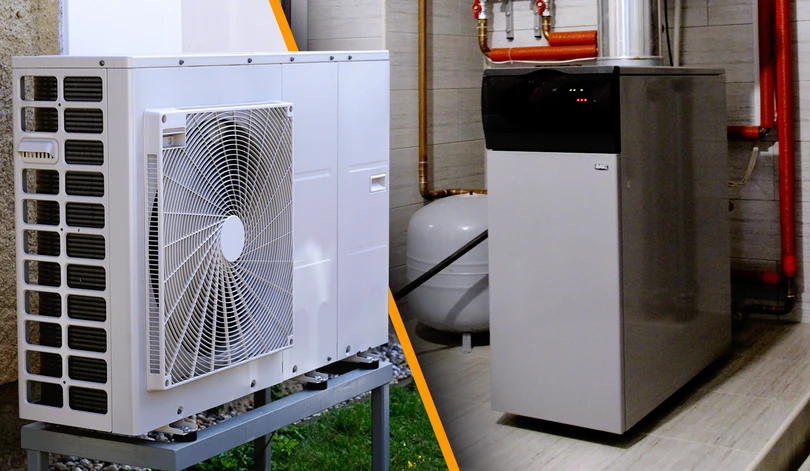
Heat Pump: An electric system that transfers heat from outside air (even in freezing temperatures) into your home using a refrigerant cycle and compressor. In summer, it reverses the process for air conditioning. Key components include an outdoor condenser unit, indoor air handler or evaporator coil, and refrigerant lines.
Gas Furnace: Burns natural gas in a combustion chamber to generate heat through a heat exchanger, then distributes warm air via ductwork using a blower. Requires natural gas lines and proper venting for combustion gases.
SEER2 (Seasonal Energy Efficiency Ratio 2): Measures cooling efficiency as total heat removed (in BTU) divided by electricity used over an entire season. Simulates real-world conditions from 65°F to 104°F.
Minimum standard: 14.3 SEER2 for split-system heat pumps. Premium models reach 22 SEER2.
HSPF2 (Heating Seasonal Performance Factor 2): Measures heating efficiency similarly to SEER2 but for the heating season.
Minimum standard: 7.5 HSPF2. High-efficiency models: 9+ HSPF2. Premium models reach 10.5+ HSPF2.
AFUE (Annual Fuel Utilization Efficiency): Measures what percentage of gas burned becomes heat for your home. An 80% AFUE furnace wastes 20% of fuel up the chimney.
Many standard gas furnaces are rated around 80% AFUE, while high-efficiency condensing models typically reach 90–98%+ AFUE.
Beginning December 18, 2028, new U.S. efficiency standards require covered non-weatherized residential gas furnaces and mobile home gas furnaces to meet a minimum 95% AFUE.
Here’s the fundamental difference: a gas furnace generates heat by burning fuel, while a heat pump uses electricity to move heat from one place to another. Because heat pumps transfer heat rather than create it directly, they can deliver several units of heating energy for every unit of electricity consumed.
This gives heat pumps a significant efficiency advantage on paper, but higher efficiency does not automatically mean lower heating bills. Actual operating costs depend on factors such as local electricity and natural gas prices, outdoor temperatures, home insulation, system efficiency, and how the equipment is installed and used.
In some homes and climates, a heat pump can substantially reduce heating costs compared with fossil-fuel heating. In others, particularly where natural gas is inexpensive, the operating-cost difference may be smaller.
One of the most common misconceptions about heat pumps is that they cannot work in cold climates. While older heat pumps often lost significant capacity as temperatures dropped, modern cold-climate heat pumps are specifically designed to operate in freezing and sub-zero conditions.
Performance varies by model. For example, the Bosch IDS Ultra can deliver up to 100% heating capacity at 5°F with a COP of 2.1 and can operate down to -13°F. Mitsubishi also offers cold-climate systems capable of maintaining 100% heating capacity at 5°F, while some models continue operating at temperatures well below 0°F.
The Lennox SL22KLV is another example of modern cold-climate technology. It offers efficiency ratings of up to 21.10 SEER2 and 10.50 HSPF2 and is designed to provide heating in outdoor temperatures as low as -20°F.
The important point is that cold-weather performance differs significantly between models. Homeowners in colder regions should compare rated heating capacity at low temperatures, HSPF2, system sizing, and whether supplemental or backup heat is recommended for their climate.
The Trade-off: Where Gas Furnaces Can Still Have Advantages
Gas furnaces can still be attractive in certain situations:
• Very cold conditions: Heat pump efficiency and heating capacity generally decline as outdoor temperatures fall. Properly selected cold-climate models can continue operating at very low temperatures, but some homes may benefit from supplemental or dual-fuel heating.
• Fast, high-temperature heating: Gas furnaces typically deliver hotter supply air and can raise indoor temperatures quickly.
• Low natural gas prices: Where natural gas is inexpensive relative to electricity, the operating-cost advantage of a heat pump may be reduced or, in some cases, reversed.
Ultimately, cold climate alone is no longer a reason to rule out a heat pump. The better choice depends on the specific equipment, local climate, energy prices, home efficiency, and existing HVAC infrastructure.
Source: EnergySage, 2026
Source: Angi, 2026
There is no single monthly heating cost that applies to every home. Operating costs depend heavily on local electricity and natural gas prices, climate, home size, insulation, thermostat settings, and equipment efficiency.
Heat Pump: Heat pumps can deliver several units of heat for each unit of electricity consumed, making them highly energy-efficient. Actual costs depend on electricity rates and how efficiently the system performs at local winter temperatures.
Gas Furnace: Gas furnaces can have lower operating costs in areas where natural gas is inexpensive relative to electricity. High-efficiency furnaces use less fuel than older models, but operating costs still depend on local gas prices and heating demand.
The key factor is your local energy-price ratio. A heat pump may cost less to operate in one region while a gas furnace may be cheaper in another. For the most accurate comparison, homeowners should compare local electricity and natural gas rates together with the efficiency of the specific systems being considered.
• Heat pumps: The federal Energy Efficient Home Improvement Credit (25C) previously covered 30% of qualifying costs, up to $2,000 per year. It is not available for property placed in service after December 31, 2025.
• Gas furnaces: Qualifying furnaces previously received a federal credit of up to $600. This 25C credit also ended for property placed in service after December 31, 2025.
Source: IRS, 2026
• Massachusetts Mass Save: Whole-home air-source heat pump rebates of $2,650 per ton, up to $8,500.
• Income-qualified households: Enhanced Mass Save incentives may provide up to $16,000 or potentially cover the full cost through qualifying programs.
• Other states and utilities: Heat pump rebates may still be available, but amounts and eligibility vary significantly by location and household income.
Sources: Mass Save, U.S. Department of Energy, 2026
Heat pumps can reduce a home’s heating-related greenhouse gas emissions because they move heat rather than generate it by burning fuel. Unlike a gas furnace, a heat pump does not produce direct combustion emissions inside the home.
The actual climate benefit depends on several factors, including the local electricity mix, outdoor temperatures, system efficiency, refrigerant management, and the efficiency of the home. In regions with cleaner electricity grids, the emissions advantage of a heat pump can be especially significant.
As electricity grids add more renewable and lower-carbon generation, the emissions associated with operating an electric heat pump can decline over its lifetime. A gas furnace, by comparison, continues to produce direct carbon dioxide emissions whenever natural gas is burned.
Natural gas also has upstream emissions associated with production, processing, transportation, and methane leakage. These factors should be considered when comparing the full environmental impact of gas heating with an electric heat pump.
Heat Pumps:
Gas Furnaces:
Actual equipment lifespan varies significantly by home and operating conditions.
Heat Pumps:
Gas Furnaces:
Both systems benefit from regular maintenance according to the equipment manufacturer’s recommendations. Maintenance needs and costs vary by system, location, usage, and service provider.
Dual-fuel systems combine an air-source heat pump with a gas furnace, automatically switching between the two based on outdoor temperature, system settings, and heating demand. The heat pump can handle much of the heating during milder weather, while the gas furnace provides backup or supplemental heat when conditions become colder.
This approach can be particularly useful in colder climates or in homes that already have a gas furnace. Whether a dual-fuel system is cost-effective depends on local electricity and natural gas prices, climate, equipment efficiency, and installation costs.
Homes in colder regions where a heat pump may benefit from supplemental heating during periods of very low outdoor temperatures.
Homes where full electrification may not yet be practical because of electrical capacity, installation costs, existing gas infrastructure, or local energy prices.
Dual-fuel systems can switch between electricity and natural gas based on temperature, energy prices, or system settings, providing homeowners with additional heating flexibility during periods of high demand.
Your optimal heating system depends on three primary factors: geographic location, existing home infrastructure, and budget priorities.
| Factor | Heat Pump | Gas Furnace | Dual-Fuel |
|---|---|---|---|
| Cold/Northern Climate | Cold-climate models can perform effectively at very low temperatures; proper sizing is important | Provides consistent heating in very cold weather | Combines heat-pump efficiency with gas backup during colder conditions |
| Mild/Moderate Climate | Often well suited because one system provides efficient heating and cooling | Effective for heating, but separate cooling equipment is typically needed | May offer less benefit where winters are mild |
| Existing Infrastructure | Available for ducted and ductless homes; electrical upgrades may sometimes be required | Most practical where gas service and suitable ductwork already exist | Particularly attractive when a home already has both ductwork and gas infrastructure |
| Upfront Cost | Typically higher than a furnace-only replacement; costs vary significantly | Generally lower upfront cost than a complete heat-pump installation | Can have higher upfront costs because both heat-pump and furnace equipment are involved |
| Operating Cost | Depends on electricity rates, climate and system efficiency | Depends on natural gas prices and furnace efficiency | Can switch between heat pump and gas heat based on temperature and system settings |
| Best Overall Fit | Homeowners seeking efficient heating and cooling in one system | Homes with existing gas infrastructure where gas remains economical | Colder-climate homes seeking the flexibility of electric and gas heating |
The heat pump vs. gas furnace decision in 2026 isn’t binary. It’s contextual.
The 2026 heating landscape has changed following the expiration of federal 25C tax credits, while new furnace efficiency standards are scheduled to take effect in 2028. That makes it especially important to compare the long-term costs and benefits of each system for your specific home.
There is no single best choice for every homeowner. Consider your climate, local electricity and natural gas rates, existing HVAC infrastructure, upfront budget, and long-term plans when choosing between a heat pump, gas furnace, or dual-fuel system.
Whatever you choose, proper system sizing and installation are critical. HVAC equipment should be sized for the home’s heating and cooling needs and installed according to manufacturer specifications. A well-designed and properly installed system can make a major difference in comfort, efficiency, and operating costs.
Looking for the best heat pump system for your home?
We’ve compared the top-rated heat pump brands based on efficiency, installation cost, performance, and real-world usage to help you make the right decision.
View our full comparison of the best heat pump systems to find the right option for your home. See which systems offer the best value in 2026.
Related Comparisons
Heat Pump vs Furnace
Heat Pump vs Air Conditioner
Heat Pump vs Mini Split
We use cookies to improve your experience, analyze traffic, and support our comparison platform. You can accept all cookies or manage your preferences.